Nexus – IoT Platform – Corvina Cloud 1.0
Exor – VPN Remote Access Service – Corvina cloud 2.0
Industrial LED Task Lights
NEXUS LIGHTS – Tower Light TL50 & TL50BL
NEXUS LIGHTS – Touch Buttons
Rockwell – Compact Logix Control System
Rockwell – Micro Control System
NEXCOM – XPPC Series
NEXCOM – IPPC
NEXCOM – Panel Monitor eTOP (MON) Series
EXOR – Compact Box Computer (eCC / eCCF Series)
EXOR – JMobile Runtime
Rockwell – FactoryTalk View ME and SE
Nexus – Customize SCADA Solution 21 CFR
NEXUS – Pick to Light
NEXUS LIGHTS – Vision Lighting
SICK – Opto-Electronic Protective Devices
SICK – Safety Switches
SICK – Safety Relays
SICK – Safety control solution
SICK – Photoelectric Sensors
SICK – Fiber Optic Sensors
SICK – Color Sensors
SICK – Ultrasonic Distance Sensors
SICK – Luminescence Sensors
SICK – Inclination Sensors
SICK – Inductive proximity sensors
SICK – Encoders
NEXUS – IVu BCR Series
SICK – Barcode Scanner CLV
NEXUS – VE Smart Series Camera
SICK – Lector Image Based Code Reader
SICK – PET Pressure sensor
SICK – PBS pressure Sensor
SICK – PBS Hygienic Pressure sensor
SICK – LFP Inox Sensor
SICK – LFC level sensor
SICK – Flow Sensor
CKD – Air Preparation Units
CKD – Water Separation Unit
CKD – Pneumatic Fittings
CKD – Process Gas component
CKD – Integrated Gas Supply System
CKD – Vacuum System Component
CKD – Electro pneumatic Regulators
CKD – 3 & 5 Port Directional Control Valve
CKD – Manual Directional Control Valve
CKD – Pilot Operated Directional Control Valves
CKD – 2 Port Diaphragm Directional Control Valve
CKD – Servo Motor Drive System
CKD – Motorless Drive
CKD – Orthogonal Combination Actuator System
CKD – Electric shutter mover
CKD – Stepper Motor Drive System
CKD – Index & Direct Drive Actuators
CKD – Powerful Arm Labour Saving Product
CKD – Digital Pressure Sensors
CKD – Flow Sensors & Controllers
YASKAWA-MP2000
YASKAWA-MP3000
WATER FLOW SWITCH- KARMAN VORTEX
Vortex flowmeters
Hydrostatic Level measurement
Absolute and gauge pressure measurement
CKD – Nitrogen Gas Extraction Unit
CKD – Air Regulator and Precision Regulator
CKD – Pneumatic Flow Controller
CKD – Pneumatic Check Valve
EXOR – eX200 Series
Yaskawa – J1000
PLC Panel
ATEX Hazardous Location Panel
PCC Panel
MCC Panel
ABB ACS – 180
ABB – ACS 380
ABB – ACS 560
ABB ACS 580
ABB ACS 880
ABB AC500
ABB AC500 ECO PLC
ABB E530 Servo Drives
ADM 1800AP Series Resistive/Capacitive Touch Monitors
ADM 1900AP Series Resistive/Capacitive Touch Monitors
BoxPC-138 Series
AMA-3821AX / 5500AX Series
AMA-812AX / 8221AX Series
AMA-7000AX Series
AMW Series
AMA-7400AX Series
ADM-2100AX Series
ARP-2900AP Series
ARP-3600AP Series
ARP-5500AX / ARP-3800AX Series
AC500-eCo V3 PLC
AC500 V3 PLC
AC500-XC PLC
AC500-S Safety PLC
AC500-S-XC Safety PLC
S500 I/O System
CP600-eCo HMI
ABB CP600 HMI
CP600-C HMI
CP600-Pro HMI
Proline Promag P 300
Proline Promag H 100
Proline Promag W 300
Proline Promag W 400
Proline Promag D 10
Proline Promag E 100
Proline Promag H 200
Proline Promag H 300
Proline Promag H 500
Proline Promag H 10
Proline Promag P 100
Proline Promag P 200
Proline Promag P 500
Proline Promag P 10
Proline Promag W 500
Proline Promag W 800
Proline Promag W 10
Dosimag electromagnetic flowmeter
Picomag Inline
Proline Promag 55S
Dosimag / 5BH
Magphant electromagnetic flowmeter
Proline Promass F 300
Proline Promass P 100
Proline Promass U 500
Proline Promass X 300
Proline Promass A 100
Proline Promass A 200
Proline Promass A 300
Proline Promass A 500
Proline Cubemass C 100
Proline Cubemass C 300
Proline Cubemass C 500
Proline Promass E 100
VFD Panel
Customised Panel Solution
Proline Promass E 200
Proline Promass E 300
Proline Promass E 500
Proline Promass F 100
Proline Promass F 200
Proline Promass F 500
Proline Promass G 100
Proline Promass H 100
Proline Promass H 300
Proline Promass H 500
Proline Promass I 100
Proline Promass I 300
Proline Promass I 500
Proline Promass K 10
Proline Promass O 100
Proline Promass O 300
Proline Promass O 500
Proline Promass P 300
Proline Promass P 500
Proline Promass Q 300
Proline Promass Q 500
Proline Promass S 100
Proline Promass S 300
Proline Promass S 500
Proline Promass X 500
Dosimass Coriolis Flowmeter
Dosimass – 8BE
Cubemass Coriolis Flowmeter
Cubemass DCI Coriolis Flowmeter
LPGmass Coriolis Flowmeter
CNGmass Coriolis flowmeter
CNGmass D8CB Coriolis Flowmeter
LPGmass D8EB Coriolis Flowmeter
LNGmass Coriolis Flowmeter
LNG Bunkering Control System DSK1LN
FLOWSIC Series Ultrasonic Gas Flowmeters
Proline Prosonic Flow Series Ultrasonic Flowmeters
Teqwave Series Ultrasonic Concentration Meters
FLOWRUN Flow Metering System
FLOWSKID flow metering system
Proline Prowirl F 200 Vortex Flowmeter
Proline Prowirl D 200 Vortex Flowmeter
Proline Prowirl O 200 Vortex Flowmeter
Proline Prowirl R 200 Vortex Flowmeter
Proline t-mass Series
Flowphant Flow Switch Series
Deltabar PMD Series – Differential Pressure Transmitters
Deltabar FMD Series Electronic Differential Pressure Systems
CKD – Anti-Microbial Bacteria Removing Filter
EXOR – eX700 Series
CKD – Standard Cylinder Actuators
Yaskawa SIGMA-7 Series
GA500 Compact Advance Vector Control Drives
EXOR – eSMART Series
CKD – Compact Cylinder Actuators
Yaskawa SIGMA-X Series
GA700 Advanced Vector Control & IoT Drive
EXOR – eXware Series
CKD – Guided Cylinder Actuator
EXOR – JSmart Series
PowerFlex 4M AC Drives
ROCKWELL – Kinetix 5300 Servo Drives
CKD – Rodless Cylinder Actuator
PowerFlex 523 and 525 AC Drives
ROCKWELL – Kinetix 5100 Servo Drives
CKD – Rotary Actuator
FT2J 7inch PLC+HMI
ROCKWELL – Kinetix 5500 Servo Drives
CKD – Grippers Actuator
CKD – SCG Pneumatic Cylinder
CKD – CMK2 Mini Pneumatic Cylinder
Not Found

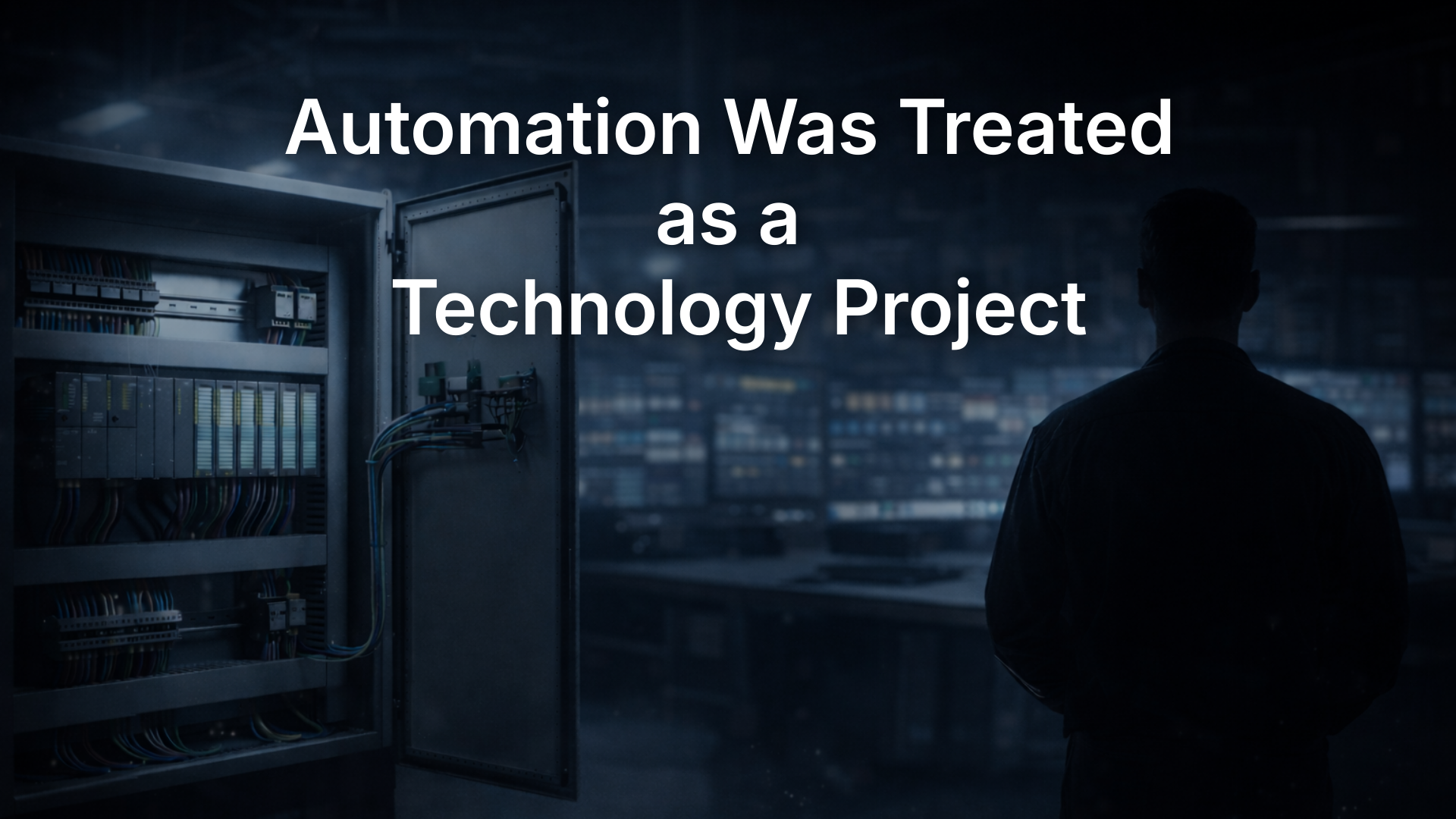
Automation Was Treated as a Technology Project

Nexus Automech

23rd January 2026

Most automation failures don’t start on the shop floor.

They start much earlier, at the project definition stage.

Long before control feels fragile.
Long before ROI becomes questionable.
Long before data exists, decisions still fail.

They start when automation is framed as a technology upgrade, instead of a system-level business intervention.

Where Automation Projects Usually Begin (and Why That’s a Problem)

In many organizations, automation initiatives begin with questions like:

  • Which PLC platform should we standardize on?

  • Which SCADA system fits our budget?

  • Which robot or drive vendor is most reliable?

These are valid technical questions, but they are not starting questions.

What’s missing are harder, more uncomfortable questions:

  • What operational constraint are we actually trying to remove?

  • Which decisions must become faster, safer, or more consistent?

  • What behavior should the plant exhibit after automation that it does not exhibit today?

  • How will performance be sustained daily, not just demonstrated at commissioning?

When these questions are skipped, automation becomes a tool deployment exercise, not a performance strategy.

Commissioning Success Is Mistaken for Operational Success

One of the most common misjudgments in automation projects is equating technical completion with business success.

Systems are declared successful because:

  • Machines run

  • Sequences execute correctly

  • Screens display data

  • Alarms trigger as designed

But none of these guarantees improved outcomes.

A system can be technically perfect and still:

  • Produce unstable output

  • Requires constant manual intervention

  • Depend on experienced individuals to “interpret” behavior

  • Drift slowly away from optimal performance

When automation is treated as a technology project, success is measured at handover, not over time.

And ROI does not live at handover.
It lives in daily operations.

Technology-First Thinking Creates Invisible Gaps

When projects start with tools instead of outcomes, several gaps quietly form.

Outcome gaps

No one can clearly explain what must improve after automation, only what was installed.

Decision gaps

Data is generated, but decision logic is not embedded. Operators still decide manually, under pressure.

Ownership gaps

Responsibility is split across departments, but no one owns system behavior as a whole.

Evolution gaps

Once commissioned, systems are rarely revisited, refined, or governed.

None of these gaps appears on project closure documents.
But all of them show up later as control loss, inefficiency, and ROI erosion.

Why ROI Becomes Accidental Instead of Engineered

High-return automation projects are not lucky.

They are deliberate.

When automation is treated as a technology project:

  • ROI depends on operator discipline

  • Performance relies on tribal knowledge

  • Improvements are reactive, not systematic

In contrast, when automation is treated as a system:

  • Decisions are embedded, not debated

  • Variability is constrained, not managed manually

  • Performance becomes repeatable, not heroic

ROI, in this case, is designed, not hoped for.

The Long-Term Cost of the Wrong Starting Point

Technology-first automation rarely fails immediately.

It fails slowly.

  • Control becomes dependent on individuals

  • Deviations are detected late, not early

  • Systems generate data, but not confidence

  • Management intervenes more, not less

Over time, automation increases complexity instead of stability.

This is why plants can look advanced on paper and still feel fragile in reality.

Automation Is Not a Technology Layer. It Is a Control Strategy.

Technology is essential, but it is never the strategy.

Automation should define:

  • How the system behaves under normal conditions

  • How it responds to deviations

  • Who owns decisions and escalation?

  • How performance is sustained, not just achieved

When automation is framed this way, tools serve the system.

When it isn’t, the system serves the tools.

A Calm Reality Check

Automation projects do not fail because the wrong PLC or SCADA was chosen.

They fail because the project was never designed around control, behavior, and outcomes.

Until automation stops being treated as a technology project and starts being treated as a business-critical control system, plants will continue to automate faster while struggling to improve consistently.

What This Explains Next

Systems Exist, But Integration Is Weak

When tools are selected first, alignment comes later, if at all.


Recent Post

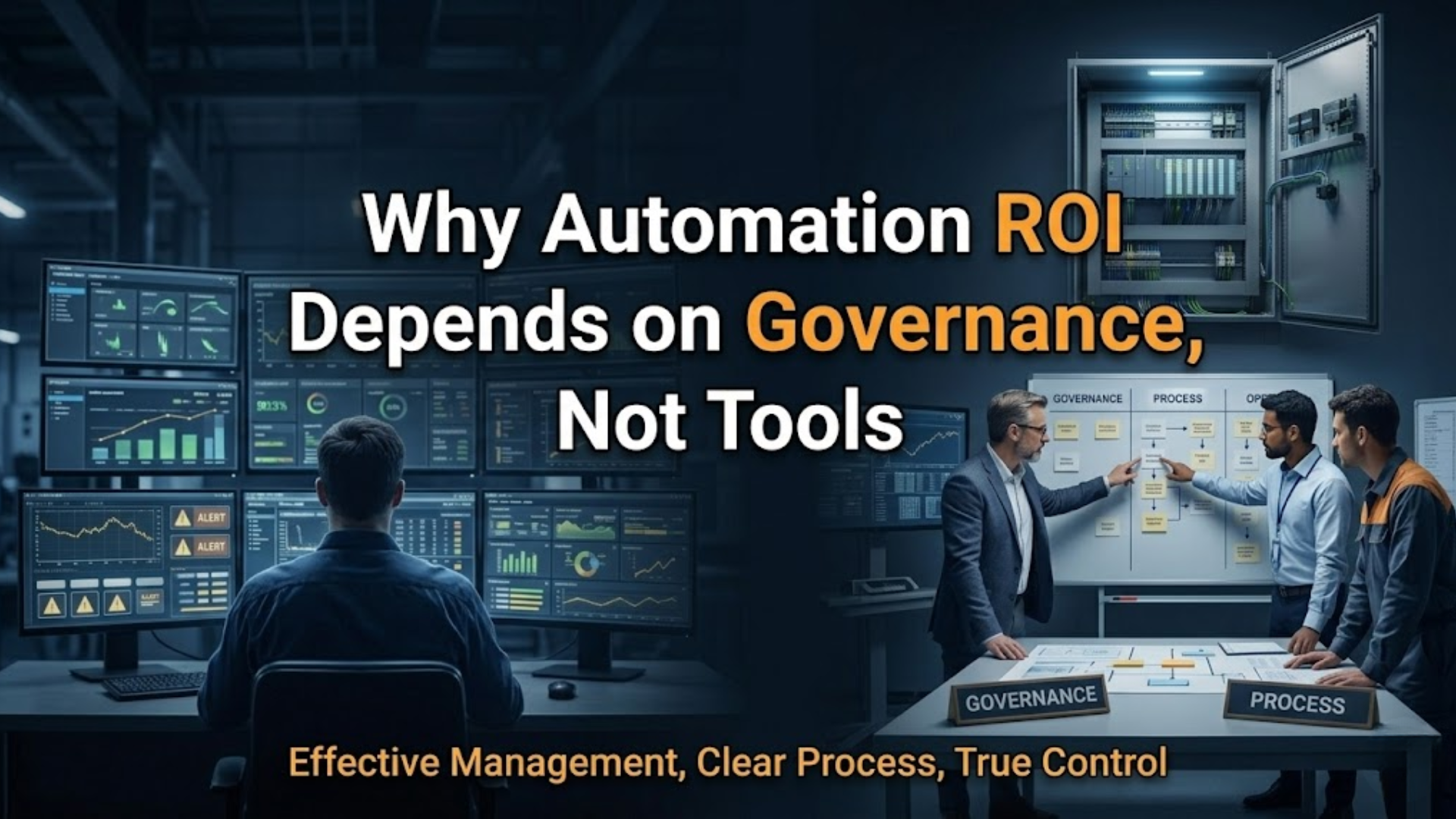
Why Automation ROI Depends on Governance, Not Tools

Read More

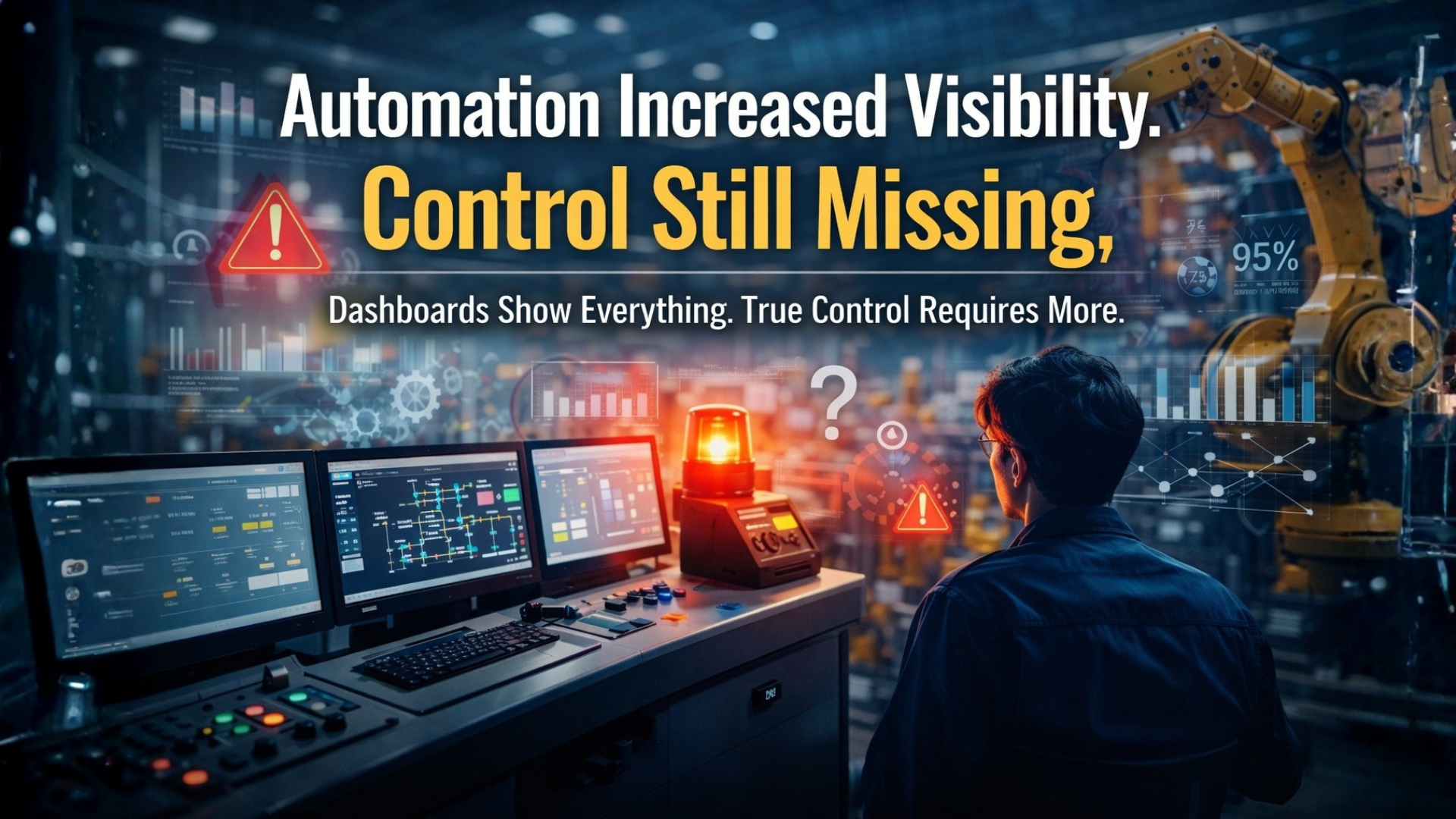
Automation Increased Visibility, Not Control

Read More

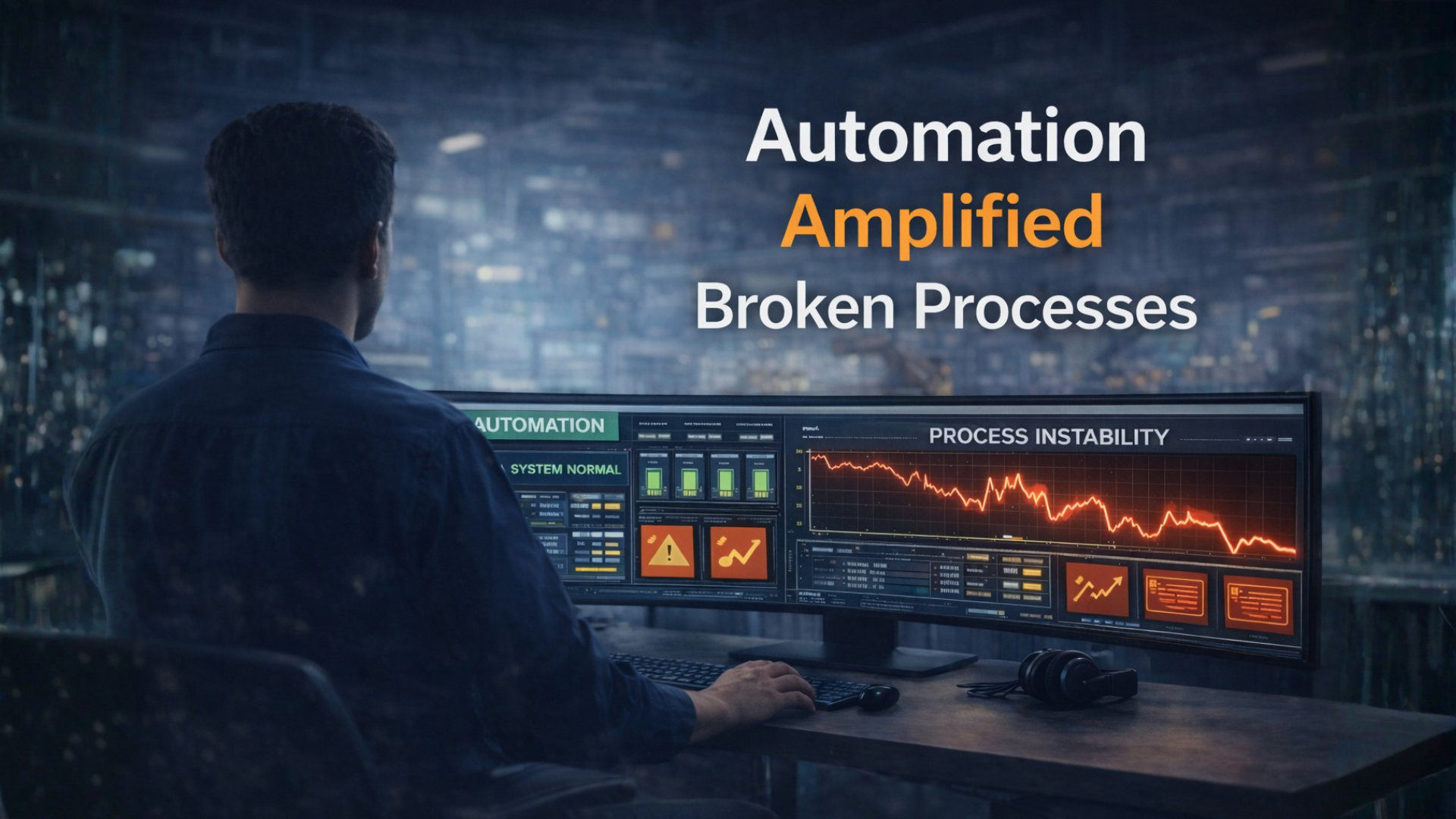
Automation Amplified Broken Processes

Read More

Never Miss A Post!

be the first to get notified about updates.

Please provide a valid Email.

Stay In Touch