Nexus Automech Pvt.Ltd. @2024. All Rights Reserved
Nexus Automech Pvt.Ltd. @2024. All Rights Reserved
Nexus Automech
16th March 2026
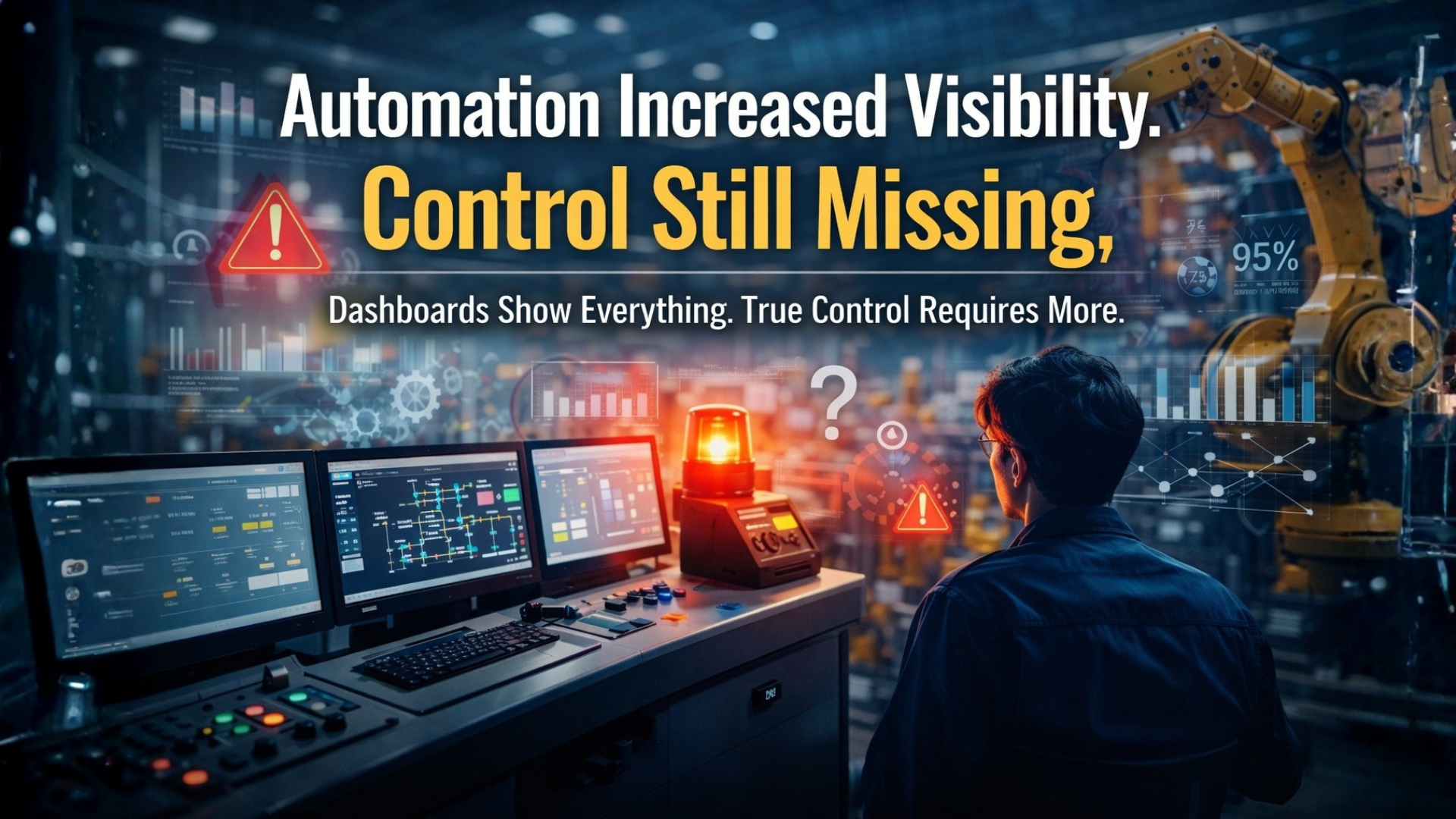
Walk through most modern manufacturing plants today, and you will see an impressive digital landscape.
Dashboards display real-time production metrics.
Control rooms monitor dozens of process variables.
Alarms notify teams when deviations occur.
Reports summarize operational performance.
From the outside, everything appears highly visible.
Yet many plants still struggle with instability, firefighting, and inconsistent performance.
The uncomfortable reality is simple:
Automation has dramatically improved visibility, but it has not always improved control.
And this gap explains why many automation projects fail to deliver ROI.
Over the past decade, industrial automation has made enormous progress in data collection and monitoring.
Modern plants now operate with:
• Real-time dashboards
• Historical data trends
• Alarm management systems
• Process historians
• Advanced analytics platforms
Operators and managers can see more information than ever before.
Production rates.
Energy consumption.
Machine utilization.
Quality parameters.
Process stability.
The plant is no longer blind.
But visibility alone does not guarantee control.
Seeing a problem does not automatically correct it.
Dashboards and alarms can easily create a powerful psychological effect.
When information becomes abundant, it feels like control has improved.
People assume:
“We can see everything now, so the system must be under control.”
But control is not defined by how much data is visible.
Control is defined by how predictably the system behaves.
A plant truly under control should demonstrate:
• Stable performance across shifts
• Predictable responses to disturbances
• Consistent quality outcomes
Reduced dependence on individual judgment
When these conditions are missing, visibility becomes something else.
It becomes an illusion of control.
This is why many plants that appear automated still experience situations where plants still lose control despite having modern systems.
Consider a common situation in a manufacturing facility.
A production dashboard shows that line efficiency has slowly declined over the past two hours.
Energy consumption is rising slightly.
Product quality remains within acceptable limits, but trends show early drift.
Everyone can see the data.
The operator notices it.
The supervisor notices it.
The control room sees it on the dashboard.
Yet nothing happens immediately.
The operator hesitates:
“Let’s wait and see if it stabilizes.”
The supervisor decides:
“Let’s observe another cycle.”
Maintenance is unaware because no critical alarm has triggered.
Two hours later, production losses have accumulated.
Nothing in the system technically failed.
The dashboards worked.
The data was accurate.
The visibility was complete.
The missing element was control logic.
Visibility answers questions such as:
• What happened?
• When did it happen?
• How often did it occur?
But control requires a different set of capabilities.
Control answers questions like:
• When must action be triggered?
• What response should occur automatically?
• Who owns the decision?
• What outcome defines success?
Without this decision structure, automation systems only inform people.
They do not guide behavior.
As a result, even highly instrumented plants often reach the same conclusion:
Despite abundant data, decisions remain manual.
And manual decision-making reintroduces variability into automated environments.
Another reason visibility fails to create control is system fragmentation.
In many plants, automation systems operate in layers:
• PLCs execute machine logic
• SCADA visualizes real-time data
• Historians store operational records
• MES tracks production performance
• ERP manages planning and cost data
Each system performs its function correctly.
But they are not always designed to act as one coordinated decision system.
Data flows upward.
But decision authority rarely flows across systems.
The PLC knows what the machine is doing.
The dashboard shows what happened.
The report summarizes performance.
Yet the systems were never designed to work together as a control architecture.
Without true integration, automation increases information but not alignment.
Many automation investments focus on improving monitoring capabilities.
Organizations invest in:
• Better dashboards
• Advanced analytics
• More KPIs
• Larger data infrastructure
These investments increase visibility.
But operational maturity must evolve at the same time.
Without clear decision frameworks:
• Dashboards create discussion instead of action
• Alerts generate noise instead of a response
• Reports summarize problems instead of preventing them
The plant becomes data-rich but control-poor.
And performance remains dependent on individual interpretation rather than system discipline.
Plants that achieve sustained automation success treat visibility as only the first step.
They move beyond monitoring toward system-driven control.
This requires designing automation systems around decision logic, not just data collection.
High-maturity plants define:
✔ Clear thresholds that trigger action
✔ Automated or semi-automated responses to deviations
✔ Ownership of operational decisions
✔ Cross-system coordination between automation layers
✔ Feedback loops that refine system behavior over time
Visibility helps identify problems.
Control ensures the system responds consistently when those problems appear.
Automation becomes more than observation.
It becomes operational discipline embedded into the system.
Not necessarily.
More data improves visibility, but control requires something else: decision design.
For automation to improve control, systems must define:
• When intervention is required
• What action should occur
• Who owns the response
• How success is measured
Without these elements, dashboards and reports only inform people about problems.
They do not prevent them.
• Automation has dramatically improved operational visibility.
• Visibility alone does not guarantee control.
• Dashboards and alarms often create an illusion of control.
• Many automated plants remain dependent on manual decisions.
• True automation maturity requires decision logic, not just data.
• Control emerges when systems guide behavior consistently.
Automation has made modern plants more visible than ever before.
But visibility is not the same as control.
Because the real question is not:
“How much data can the system show?”
The real question is:
“Does the system know how to respond when the data changes?”
Only when automation moves from visibility to decision-driven control does performance truly stabilize.