Nexus Automech Pvt.Ltd. @2024. All Rights Reserved
Nexus Automech Pvt.Ltd. @2024. All Rights Reserved
Nexus Automech
30th January 2026
In many industrial plants today, automation systems are not missing.
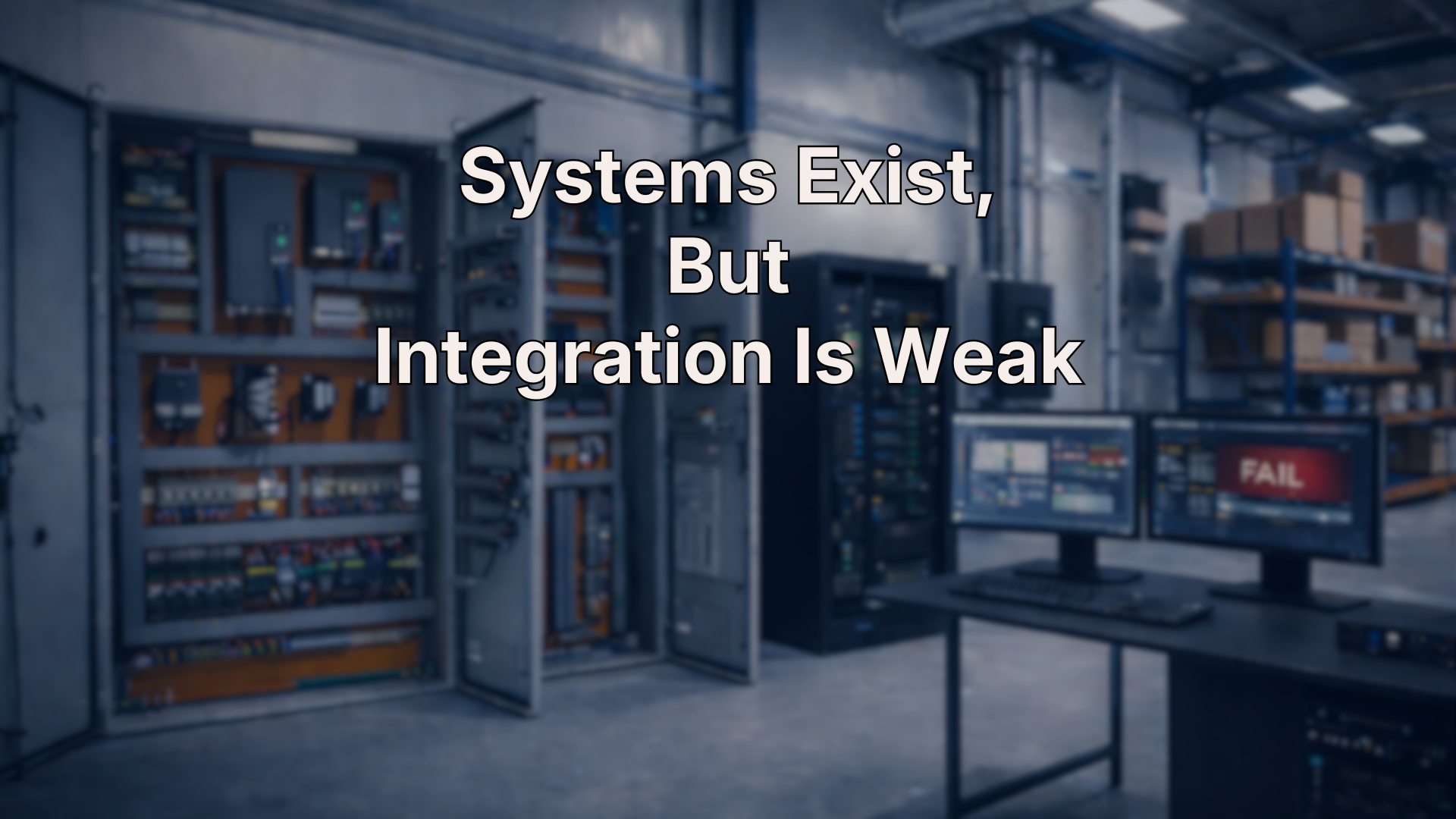
PLCs are installed. SCADA screens are active. Historians are collecting data. MES and ERP systems are present and technically connected.
Yet despite all this infrastructure, plants still struggle with delays, firefighting, and inconsistent decisions.
The problem is not the absence of systems.
The problem is that these systems were never designed to work as one decision-making system.
Most automation initiatives are executed in layers:
• PLC teams focus on control logic
• SCADA teams focus on visualisation and alarms
• IT teams focus on data pipelines
• Business teams focus on reports and KPIs
Each layer performs its assigned role.
But they are designed and delivered in isolation.
Data moves upward, but context does not move across systems.
The PLC understands the process state.
SCADA shows what is happening.
MES counts production.
ERP summarises cost and output.
What is missing is a shared understanding of cause, impact, and priority.
As a result, problems are visible everywhere, but owned nowhere.
Many plants believe integration is achieved because systems are technically connected and dashboards are populated.
But connectivity only answers where data goes.
Integration answers how decisions are made.
True integration requires:
• Shared definitions across systems
• Aligned timing between events and decisions
• Clear ownership of actions
• Consistent decision logic from the shop floor to management
Without this alignment, automation only increases information volume, not decision quality.
This is one of the core reasons automation ROI fails to materialise.
When systems are weakly integrated, the same operational patterns appear repeatedly:
• Production issues are detected late
• Root causes are debated instead of proven
• Operators wait for supervisors
• Supervisors wait for reports
• Management reacts after losses are already incurred
Automation becomes a reporting mechanism, not a control system.
This is where ROI slowly erodes, not through failure, but through delay, indecision, and manual intervention.
Weak integration is rarely accidental.
It is the natural outcome of technology-first automation projects.
Most projects begin by selecting PLC platforms, SCADA software, robots, or historians before defining:
• What decisions must be automated
• Who owns those decisions
• How systems should respond to deviations
Each vendor optimises its own scope.
Cross-system logic is postponed to a later phase, often labelled “future integration” or “phase two”.
This thinking is explained in detail when automation is treated purely as a technology project.
By the time integration is discussed seriously, budgets are exhausted, and timelines are closed.
The plant is left with an operationally fragmented and technically complete system.
Plants struggling with integration often accept the following as normal:
• Operators relying on experience instead of system guidance
• Engineers exporting data to Excel for analysis
• Alarms are being acknowledged without corrective action
• Planning and production are working on different assumptions
• Maintenance responding reactively instead of predictively
These are not people's failures.
They are system design failures.
Effective integration does not start with software architecture.
It starts by defining:
• Which decisions must be made in real time
• Which decisions must be escalated
• What data is required at each decision point
• What actions are automatic versus manual
Only after this is clear should PLC logic, SCADA visualisation, MES workflows, and ERP rules be aligned.
Without this discipline, automation remains a collection of tools, not a coordinated system.
When systems do not share decision logic:
• Visibility increases, but control decreases
• Problems are seen earlier, but resolved later
• Manual intervention slowly replaces automated intent
This explains why many automation projects look successful, yet fail to deliver sustained performance improvement.
They delivered systems.
They did not deliver control.
Automation ROI does not fail because plants lack technology.
It fails because systems were never designed to think and act together.
Until integration is treated as a decision-architecture problem, not a connectivity task, automation will continue to underperform, regardless of how advanced the tools appear.