Nexus – IoT Platform – Corvina Cloud 1.0
Exor – VPN Remote Access Service – Corvina cloud 2.0
Industrial LED Task Lights
NEXUS LIGHTS – Tower Light TL50 & TL50BL
NEXUS LIGHTS – Touch Buttons
Rockwell – Compact Logix Control System
Rockwell – Micro Control System
NEXCOM – XPPC Series
NEXCOM – IPPC
NEXCOM – Panel Monitor eTOP (MON) Series
EXOR – Compact Box Computer (eCC / eCCF Series)
EXOR – JMobile Runtime
Rockwell – FactoryTalk View ME and SE
Nexus – Customize SCADA Solution 21 CFR
NEXUS – Pick to Light
NEXUS LIGHTS – Vision Lighting
SICK – Opto-Electronic Protective Devices
SICK – Safety Switches
SICK – Safety Relays
SICK – Safety control solution
SICK – Photoelectric Sensors
SICK – Fiber Optic Sensors
SICK – Color Sensors
SICK – Ultrasonic Distance Sensors
SICK – Luminescence Sensors
SICK – Inclination Sensors
SICK – Inductive proximity sensors
SICK – Encoders
NEXUS – IVu BCR Series
SICK – Barcode Scanner CLV
NEXUS – VE Smart Series Camera
SICK – Lector Image Based Code Reader
SICK – PET Pressure sensor
SICK – PBS pressure Sensor
SICK – PBS Hygienic Pressure sensor
SICK – LFP Inox Sensor
SICK – LFC level sensor
SICK – Flow Sensor
CKD – Air Preparation Units
CKD – Water Separation Unit
CKD – Pneumatic Fittings
CKD – Process Gas component
CKD – Integrated Gas Supply System
CKD – Vacuum System Component
CKD – Electro pneumatic Regulators
CKD – 3 & 5 Port Directional Control Valve
CKD – Manual Directional Control Valve
CKD – Pilot Operated Directional Control Valves
CKD – 2 Port Diaphragm Directional Control Valve
CKD – Servo Motor Drive System
CKD – Motorless Drive
CKD – Orthogonal Combination Actuator System
CKD – Electric shutter mover
CKD – Stepper Motor Drive System
CKD – Index & Direct Drive Actuators
CKD – Powerful Arm Labour Saving Product
CKD – Digital Pressure Sensors
CKD – Flow Sensors & Controllers
YASKAWA-MP2000
YASKAWA-MP3000
WATER FLOW SWITCH- KARMAN VORTEX
Vortex flowmeters
Hydrostatic Level measurement
Absolute and gauge pressure measurement
CKD – Nitrogen Gas Extraction Unit
CKD – Air Regulator and Precision Regulator
CKD – Pneumatic Flow Controller
CKD – Pneumatic Check Valve
EXOR – eX200 Series
Yaskawa – J1000
PLC Panel
ATEX Hazardous Location Panel
PCC Panel
MCC Panel
ABB ACS – 180
ABB – ACS 380
ABB – ACS 560
ABB ACS 580
ABB ACS 880
ABB AC500
ABB AC500 ECO PLC
ABB E530 Servo Drives
ADM 1800AP Series Resistive/Capacitive Touch Monitors
ADM 1900AP Series Resistive/Capacitive Touch Monitors
BoxPC-138 Series
AMA-3821AX / 5500AX Series
AMA-812AX / 8221AX Series
AMA-7000AX Series
AMW Series
AMA-7400AX Series
ADM-2100AX Series
ARP-2900AP Series
ARP-3600AP Series
ARP-5500AX / ARP-3800AX Series
AC500-eCo V3 PLC
AC500 V3 PLC
AC500-XC PLC
AC500-S Safety PLC
AC500-S-XC Safety PLC
S500 I/O System
CP600-eCo HMI
ABB CP600 HMI
CP600-C HMI
CP600-Pro HMI
Proline Promag P 300
Proline Promag H 100
Proline Promag W 300
Proline Promag W 400
Proline Promag D 10
Proline Promag E 100
Proline Promag H 200
Proline Promag H 300
Proline Promag H 500
Proline Promag H 10
Proline Promag P 100
Proline Promag P 200
Proline Promag P 500
Proline Promag P 10
Proline Promag W 500
Proline Promag W 800
Proline Promag W 10
Dosimag electromagnetic flowmeter
Picomag Inline
Proline Promag 55S
Dosimag / 5BH
Magphant electromagnetic flowmeter
Proline Promass F 300
Proline Promass P 100
Proline Promass U 500
Proline Promass X 300
Proline Promass A 100
Proline Promass A 200
Proline Promass A 300
Proline Promass A 500
Proline Cubemass C 100
Proline Cubemass C 300
Proline Cubemass C 500
Proline Promass E 100
VFD Panel
Customised Panel Solution
Proline Promass E 200
Proline Promass E 300
Proline Promass E 500
Proline Promass F 100
Proline Promass F 200
Proline Promass F 500
Proline Promass G 100
Proline Promass H 100
Proline Promass H 300
Proline Promass H 500
Proline Promass I 100
Proline Promass I 300
Proline Promass I 500
Proline Promass K 10
Proline Promass O 100
Proline Promass O 300
Proline Promass O 500
Proline Promass P 300
Proline Promass P 500
Proline Promass Q 300
Proline Promass Q 500
Proline Promass S 100
Proline Promass S 300
Proline Promass S 500
Proline Promass X 500
Dosimass Coriolis Flowmeter
Dosimass – 8BE
Cubemass Coriolis Flowmeter
Cubemass DCI Coriolis Flowmeter
LPGmass Coriolis Flowmeter
CNGmass Coriolis flowmeter
CNGmass D8CB Coriolis Flowmeter
LPGmass D8EB Coriolis Flowmeter
LNGmass Coriolis Flowmeter
LNG Bunkering Control System DSK1LN
FLOWSIC Series Ultrasonic Gas Flowmeters
Proline Prosonic Flow Series Ultrasonic Flowmeters
Teqwave Series Ultrasonic Concentration Meters
FLOWRUN Flow Metering System
FLOWSKID flow metering system
Proline Prowirl F 200 Vortex Flowmeter
Proline Prowirl D 200 Vortex Flowmeter
Proline Prowirl O 200 Vortex Flowmeter
Proline Prowirl R 200 Vortex Flowmeter
Proline t-mass Series
Flowphant Flow Switch Series
Deltabar PMD Series – Differential Pressure Transmitters
Deltabar FMD Series Electronic Differential Pressure Systems
CKD – Anti-Microbial Bacteria Removing Filter
EXOR – eX700 Series
CKD – Standard Cylinder Actuators
Yaskawa SIGMA-7 Series
GA500 Compact Advance Vector Control Drives
EXOR – eSMART Series
CKD – Compact Cylinder Actuators
Yaskawa SIGMA-X Series
GA700 Advanced Vector Control & IoT Drive
EXOR – eXware Series
CKD – Guided Cylinder Actuator
EXOR – JSmart Series
PowerFlex 4M AC Drives
ROCKWELL – Kinetix 5300 Servo Drives
CKD – Rodless Cylinder Actuator
PowerFlex 523 and 525 AC Drives
ROCKWELL – Kinetix 5100 Servo Drives
CKD – Rotary Actuator
FT2J 7inch PLC+HMI
ROCKWELL – Kinetix 5500 Servo Drives
CKD – Grippers Actuator
CKD – SCG Pneumatic Cylinder
CKD – CMK2 Mini Pneumatic Cylinder
Not Found

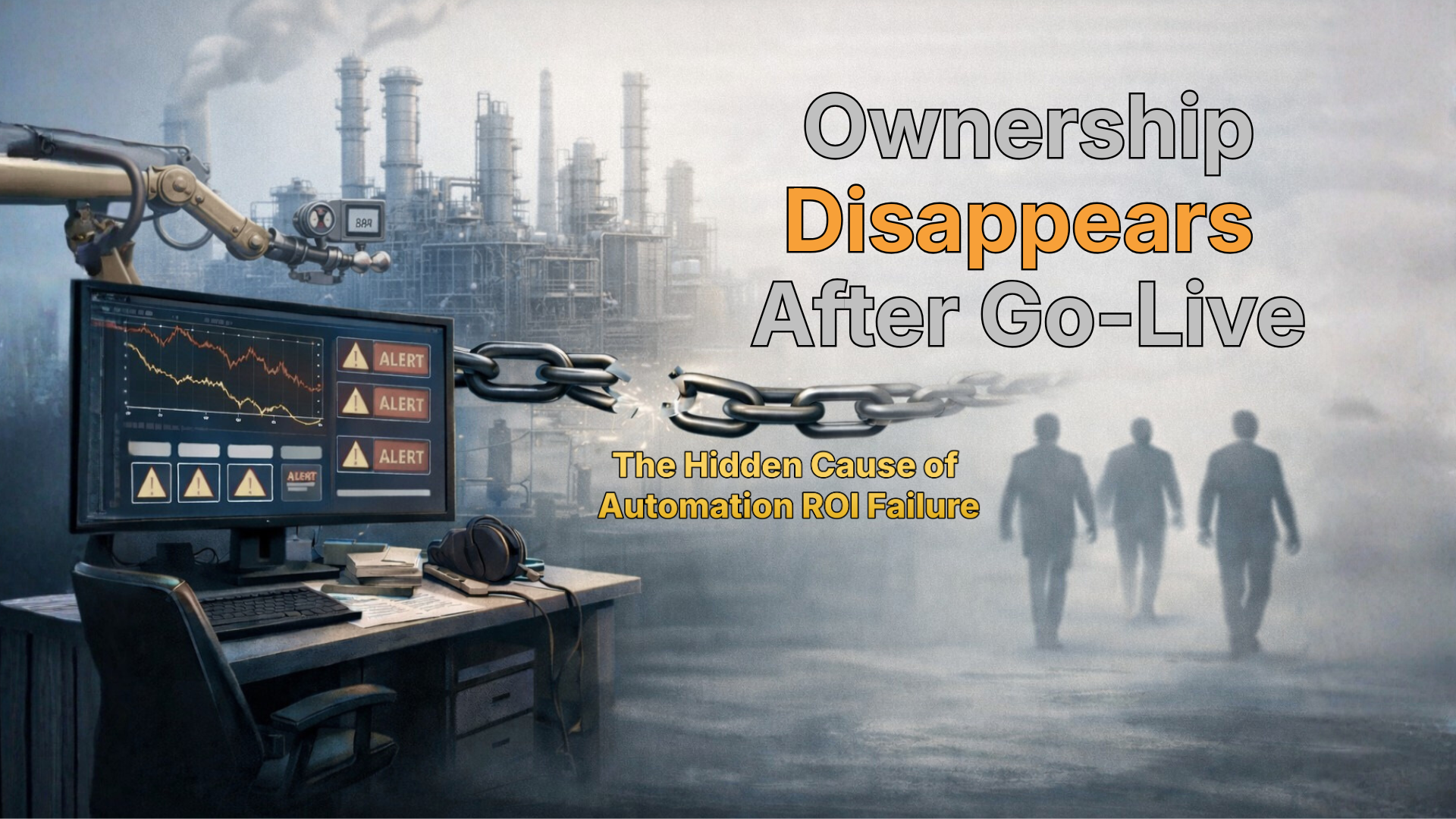
Ownership Disappears After Go-Live

Nexus Automech

21st February 2026

Automation systems rarely collapse.

They drift.

Not because logic fails.
Not because hardware breaks.
But because ownership dissolves.

The system runs.

Responsibility fades.

And automation ROI quietly begins to erode.

Automation failure is rarely technical.
It is almost always structural.

The Transition Most Plants Never Design

During an automation project, ownership is obvious.

There is structure:

• Project managers
• System integrators
• Vendors
• Review checkpoints
• Defined deliverables

Accountability is embedded into the project framework.

Then go-live happens.

Automation transitions from:

Project Asset → Operational Infrastructure

This shift is rarely governed with the same rigor.

Delivery discipline ends.
Governance discipline never begins.

Post Go-Live Reality: Who Owns the System Now?

After commissioning, responsibility typically fragments:

  • Maintenance → Hardware reliability
  • IT / Automation Team → Servers, backups, networks
  • Operations → Production targets
  • Vendors → “Major changes”

But one critical role is missing:

System Performance Ownership

No department fully owns:

  • Logic evolution
  • Decision rule refinement
  • Threshold optimization
  • Alarm strategy governance
  • Behavioral alignment

The system is everyone’s tool.
The system is no one’s responsibility.

A Familiar Industrial Scenario

Consider a common post-go-live situation.

A production instability appears:

  • Minor oscillations.
  • Repeated operator overrides.
  • Efficiency fluctuations.

The responses unfold predictably:

Operations → “Control logic needs tuning.”
Maintenance → “Hardware is functioning normally.”
Automation Team → “System behaving as designed.”
Vendor → “Requires change request approval.”

Meetings happen.

Emails circulate.

Weeks pass.

No decisive evolution occurs.

Not due to incompetence.
But due to automation accountability gaps.

(Because accountability gaps often stem from system fragmentation)

Automation Without Ownership Becomes Passive Infrastructure

When automation ownership is unclear:

  ✔ Logic reflects outdated assumptions
  ✔ Decision thresholds lose relevance
  ✔ Alarm strategies decay
  ✔ Dashboards become informational noise
  ✔ Manual interventions increase
  ✔ Workarounds normalize

This is not a system failure.
This is automation lifecycle mismanagement.

Why Ownership Disappears So Easily

Ownership collapse is rarely accidental.

It is structurally designed through common patterns:

  • Automation treated as CapEx installation
  • No automation governance framework
  • No KPI tied to system effectiveness
  • No budget for logic refinement
  • Vendor dependency mindset
  • Departmental silos
  • Absence of lifecycle reviews

Technology is installed.

Governance is postponed.

Tools are purchased.
Systems are never truly owned.

The Hidden Cost of Ownership Gaps

When automation ownership is undefined:

  • Deviations persist longer
  • Optimizations stall
  • Cross-system conflicts remain unresolved
  • Decision delays increase
  • Manual dependency rises
  • System confidence declines
  • ROI decay accelerates

Nothing visibly breaks.
Yet control weakens steadily.

High-Maturity Plants Treat Ownership Differently

Plants that sustain automation ROI establish:

✔ System Ownership

Defined authority over logic, thresholds, alarms, and decisions.

✔ Governance Discipline

Regular logic refinement & behavioral alignment.

✔ Lifecycle Management

Automation is treated as an evolving performance infrastructure.

✔ Cross-Functional Authority

System decisions are not trapped in departmental silos.

✔ Performance-Driven KPIs

System effectiveness is measured, not assumed.

Automation becomes governed intelligence.
Not passive tooling.

Ownership Is Not Maintenance

Owning automation does not mean:

  • Fixing faults
  • Replacing components
  • Managing backups

True automation ownership means:

  • Aligning logic with operational reality
  • Governing decision frameworks
  • Refining thresholds & alarm strategies
  • Driving performance adaptation
  • Preventing drift before failure

Ownership is governance.
Governance is ROI protection.

The Uncomfortable Industrial Truth

Automation systems do not drift because they age.

They drift because:

No structure owns its evolution

Technology cannot self-govern.

Organizations must.

Closing Thought

Automation ROI rarely disappears at go-live.

It declines when ownership disappears.

Because the defining question is never:

“Is the system operational?”

The real question is:

“Who is accountable for how the system must evolve?”


Recent Post

Why Automation ROI Depends on Governance, Not Tools

Read More

Automation Increased Visibility, Not Control

Read More

Automation Amplified Broken Processes

Read More

Never Miss A Post!

be the first to get notified about updates.

Please provide a valid Email.

Stay In Touch